
Evolution cannot be the genesis of Morality
morality is 3D, evolution only sees its shadow

The shadow on the wall
Imagine you’re looking at shadows on a wall. A cylinder and a rectangular box can cast the exact same rectangular shadow. No matter how long you stare at the shadow you cannot determine which object cast it. The shadow faithfully captures two dimensions but erases the third.

This turns out to be a precise analogy for a deep problem in evolutionary biology, one with surprising implications for where morality comes from.
Three levels of causal reasoning
We’ll start with something far away (sort of ) from evolution: learning theory. In the 1990s and 2000s, computer scientist Judea Pearl formalized something philosophers had long sensed: there are fundamentally different levels of causal knowledge, and you can’t get to a higher level just by having more data from a lower one.
Level 1: Association/Prediction. What patterns do you see? Patients who take this drug recover more often. People who carry umbrellas tend to encounter rain. This is correlation, pure observation. When you blindly build a predictive model (like an LLM), you are operating at level 1.
Level 2: Doing. What happens when you intervene? If you actually give the drug to a random patient, do they recover? If you force someone to carry an umbrella, does it rain? This is the level of experiments and actions. It’s strictly more powerful than Level 1, you can answer questions that no amount of passive observation can settle.
Level 3: Counterfactuals. What would have happened if things had been different? This specific patient took the drug and recovered, but would they have recovered without it? Not patients in general, this person, in these circumstances. This is counterfactual reasoning, and it turns out to be fundamentally different from both observation and experimentation.
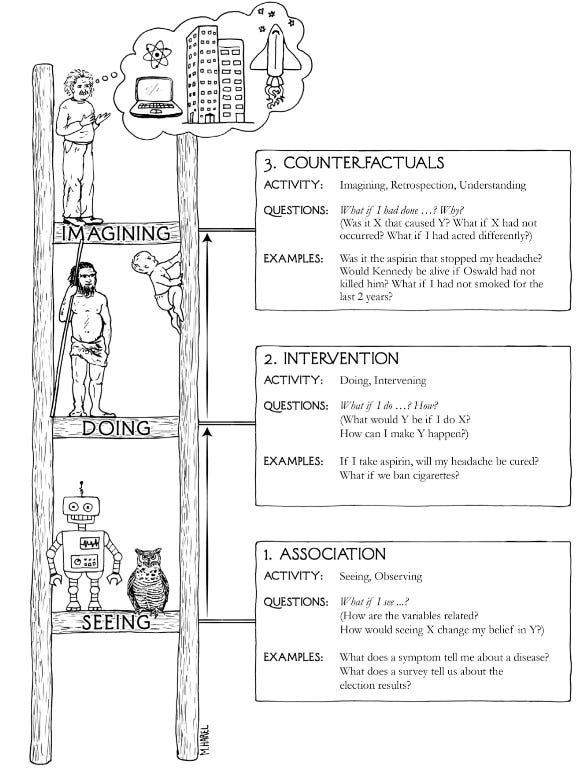
Pearl and colleagues proved mathematically that for almost all causal systems, Level 2 data does not determine Level 3 answers (same for Level 1 to Level 2). You can run every possible experiment, collect every possible interventional dataset, and still not know the answer to “what would have happened.” The information simply isn’t there. It’s the depth that the shadow erases.
What evolution can see
Here’s where it gets interesting. What does natural selection actually see?
An organism acts in the world and either survives and reproduces, or doesn’t. Evolutionary Fitness is computed from outcomes: what happened when the organism did what it did. These outcomes are Level 2 quantities. Evolution is, at its core, a process that evaluates organisms based on their interventional profiles, i.e. what results they produce when they act. This result is called Evolvability was proven by Leslie Valiant in 2008. If we want to get technical, evolution is a CSQ learner and operates at Level 2.
This means evolution is looking at shadows.
Two organisms with completely different internal models of how the world works at the counterfactual level, meaning they have different beliefs about what would have happened under different circumstances, will have identical fitness as long as their Level 2 behavior matches. Evolution literally cannot tell them apart. The fitness channel carries zero information about the “depth” dimension, the Level 3 content.
This is very far from being a practical limitation that could be overcome with more time or larger populations. It’s an information-theoretic impossibility. Zero capacity multiplied by 1 billion years of evolution is still zero. You can’t learn depth from a shadow, no matter how long you look.
So what?
You might ask: who cares about Level 3? If Level 2 is enough to act optimally in the world, run the right experiments, make the right decisions, then why does the “what would have happened” question matter?
It matters because morality matters.
Morality lives at Level 3
Think about blame. “You shouldn’t have done that” isn’t a statement about population statistics. It’s a claim about a specific person in specific circumstances: could they have done otherwise? Would things have turned out differently but for their action?
Think about legal responsibility. “But for the defendant’s negligence, would the harm have occurred?” This is an individual-level counterfactual, a Level 3 question by definition. No population average can answer it.
Think about regret. “I should have chosen differently” compares what actually happened with what would have happened under a different choice, for you, at that moment, in those circumstances.
These aren’t fancy elaborations of simpler concepts. They are the concepts. Without “could have done otherwise,” blame is just retaliation. Without “but for your action,” responsibility is just consequence-tracking. Without “what would have happened,” regret is simply displeasure.
Some amoral examples: Chimpanzees retaliate against cheaters. Ants defend colonies. Vampire bats share food with those who shared with them. All of this is Level 2 coordination. Sophisticated, effective, and requiring zero counterfactual reasoning. But none of it is morality. Morality defined by blame, guilt, responsibility, and justice is what behavioral coordination becomes when you add the counterfactual dimension. And that dimension is exactly what evolution cannot tune through fitness because it only sees the shadow.
The inseparable package
This leads to a striking prediction. If evolution can’t produce reliable Level 3 content, and morality requires Level 3 content, then morality must come from somewhere else. The most plausible candidate is cultural transmission, the ability to pass structural assumptions about how the world the moral world works from one generation to the next through language, teaching, institutions, and shared frameworks.
Cultural transmission requires cumulative culture: the ratchet-like buildup of knowledge across generations. And structured counterfactual reasoning is both the content being transmitted and a prerequisite for the kind of teaching and norm-sharing that transmits it.
The prediction, then, is that three traits form an inseparable package:
Cumulative culture (the delivery mechanism)
Structured counterfactual reasoning (the content delivered)
Moral systems (what coordination becomes when counterfactual frameworks are applied to social life)
No non-human animal has any of the three. Not structured counterfactual reasoning, not genuine moral systems, not cumulative culture. This joint absence across every other species is exactly what the theory predicts.
What evolution can produce
To be clear about what the argument concedes: evolution can hypothetically produce the computational machinery for something like counterfactual reasoning. Mental simulation, hypothetical thinking, planning by imagining outcomes…all of these have clear Level 2 fitness benefits. An organism that can mentally simulate “what would happen if I tried to cross this river” plans better and survives more.
What evolution cannot produce is the correct calibration of that machinery for Level 3 questions. It’s like evolution building a telescope perfectly capable of seeing distant galaxies, but having no way to aim it correctly because the information about where to point comes from a source evolution has no access to.
What evolution can produce is what you might call a counterfactual speculator: an organism with the architecture to generate “what if” hypotheses, but whose specific answers to those questions are artifacts of how the machinery was built, not learned features of the world.
The cultural bootstrap
If not evolution, then what? The answer appears to be culture, but with an important nuance.
Shared moral frameworks don’t need to be correct to be useful. A society with a shared but-for test for blame, “would the harm have occurred but for your action?”, benefits from coordination, deterrence, and conflict resolution regardless of whether its counterfactual framework perfectly tracks reality. What matters is that the framework is shared, not that it’s calibrated.
This dissolves a potential regress. You don’t need someone to first figure out the “right” counterfactual answers before culture can transmit them. You need:
Evolution provides the architecture for counterfactual speculation
Language enables sharing of structural assumptions
Social coordination pressure selects for shared frameworks (a Level 2 benefit)
The specific content of those frameworks, tort law, moral philosophy, the concept of mens rea, is a cultural product, refined over centuries
The legal concept of “but for” causation, the philosophical tradition of moral responsibility, the everyday practice of blame and praise, these are all cultural technologies for managing the Level 3 dimension of social life. They are transmitted through education, institutions, and moral discourse. They vary across cultures in ways that pure evolutionary accounts cannot explain. And they are exactly what the theory predicts must exist.
What this means for the oldest debate in ethics
Philosophers have long debated whether morality is objective, written into the fabric of reality, discoverable like the laws of physics, or subjective, invented by humans, varying across cultures, ultimately a matter of preference. The Level 2/Level 3 distinction has something to say about both horns of this debate.
Can evolution track objective moral truths? No. This is the result’s sharpest consequence for metaethics. Philosophers like Sharon Street have argued that if evolution shaped our moral beliefs, then either those beliefs track moral truth or they don’t, and neither option is comfortable for moral realism. Our result resolves her dilemma: the tracking horn doesn’t just lack a scientific explanation, it is provably impossible for the counterfactual component of morality, undermining the idea that morality arises from evolution at all. The evolutionary channel has zero capacity for Level 3 information. Evolution cannot track moral truths that depend on counterfactual reasoning, not because it hasn’t had enough time, not because the problem is hard, but because the information isn’t in the channel. Zero times one billion years is still zero.
This strengthens a related argument from Richard Joyce: even without knowing the full story of where moral beliefs come from, we can be confident that evolution isn’t the part that got the counterfactual component right. Joyce argued that evolution provides a complete non-moral explanation for moral beliefs, which defeats our warrant for trusting them. Our result goes further, it doesn’t matter whether the explanation is complete. Even a partial evolutionary explanation cannot fill the zero-capacity channel.
Is objective morality defensible at all? Yes…but not through evolution. Some Level 2 content of morality is “objective” in the sense that it corresponds to fitness outcomes, but the sum total encompasses far more than bare survival pressures. Which social codes promote cooperation and which corrode it. What emotional responses track real social threats versus imagined ones. Whether punishment structures actually deter harmful behavior. How resource-sharing norms affect group stability. Whether empathy-based interventions produce the outcomes they aim for. These are all testable, evidence-responsive questions, Level 2 questions with Level 2 answers. The shame response, which tracks threats to social reputation with remarkable cross-cultural consistency, is a paradigmatic example: it doesn’t require any counterfactual reasoning, just accurate prediction of how others will react. Shame is ubiquitous across cultures, but the content of shame varies.
Moral realists who defend morality’s objectivity through what philosophers call autonomous rational reflection, general reasoning capacities operating independently of evolved instinct, are not rejected by our result. Utilitarian reasoning that overrides kin-favoritism, justice principles that override in-group preference, abstract moral arguments that contradict gut instinct, these are less mysterious now. They are exactly what you’d expect if moral content has a non-evolutionary source. The Level 2/Level 3 boundary provides a principled, non-ad-hoc criterion for when “autonomous reflection” is doing genuine work: it’s doing work whenever the moral judgment depends on counterfactual structure that evolution couldn’t have provided.
Finally, our theorem is consistent with a subjective account of morality but undercuts its most comfortable origin story. If morality doesn’t arise from evolutionary pressures, and is transmitted culturally, what was the genesis point of our cultural assumptions? That too remains an open question for the subjectivist, indeed us all.
The gap
There is a gap our theorem doesn’t touch. If evolution didn’t produce the first Level 3 assumptions, what did? This is an open question, perhaps the deepest one the theory surfaces. Cultural transmission explains how counterfactual frameworks propagate across generations, and shared coordination pressure explains why they persist. But someone, somewhere, had to produce the first structural assumptions about counterfactual causation that a community could then adopt, refine, and transmit. The theory identifies the shape of the answer, the assumptions must have entered through a non-evolutionary channel, without filling in its origin. The proof only tells us where the answer cannot come from.
The view from here
The argument is ultimately about information: what kind of information different channels can carry. Evolution’s channel, fitness, operates at Levels 1 and 2. It may have produced eyes, immune systems, and brains capable of sophisticated causal reasoning about the observable world. But it is mathematically silent on Level 3.
This sharpens our understanding of what evolution is capable of, and suggests that humanity’s moral capacity is not merely a more sophisticated version of the social instincts we share with other animals, but something categorically different, made possible by a transmission channel, culture, that no other species possesses and whose origin is an open question scientifically.
Theologically, we may already have an answer.
Footnotes
A lot of mathematical details were left out for the sake of brevity
I am working on a pending paper that formalizes the arguments laid out here
This paper will be submitted for peer review and will be accompanied by a Lean proof of the underlying mathematics combining evolvability and the Causal Hierarchy Theorem results showing that L2 is measure zero with respect to L3